
Trump’s economic policies, taken holistically, illustrate the ingenuity Cuban and millions of others fail to recognize.
In a momentous X Post, Mark Cuban purports to simplify the math on why Democrat policy on tariffs and trade is superior to Trump’s.
Here’s the text from the post:
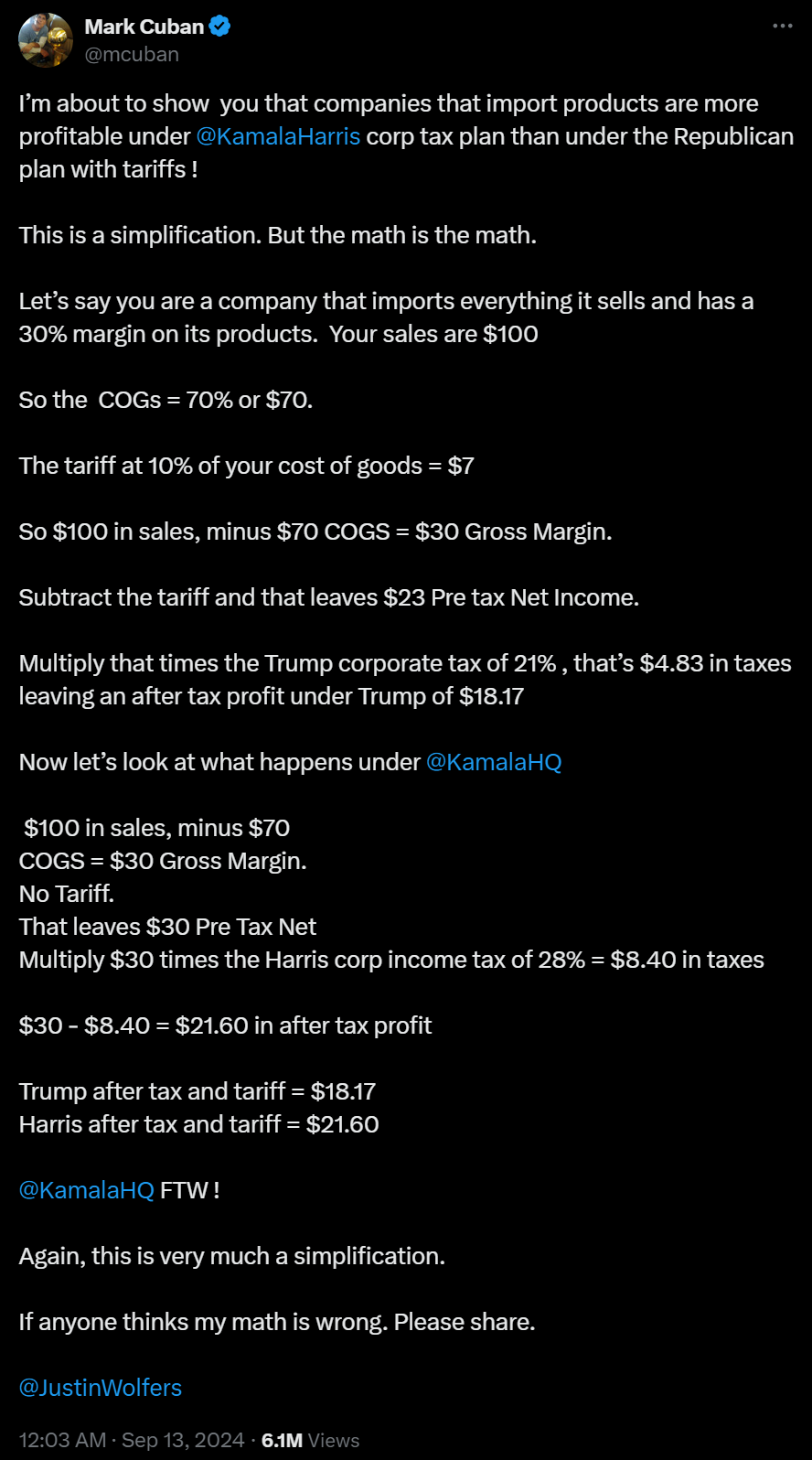
This is a subject that strikes close to home for me from multiple angles. In college, I studied Economics at a school heavily influenced by the Koch brothers and am a fervent supporter of Austrian Economics – F. A. Hayek over John Maynard Keynes. I strongly supported the Ron Paul for 2012 Campaign and considered myself a libertarian – that is, until Trump came down that infamous escalator.
Although I supported many of Trump’s campaign promises, such as building the wall in 2016 early on, I could not get over the fact that his call for Tariffs went against everything I’d learned in college and everything I’d read since then. I sat in my car at my polling station in 2016, still unsure of whether to vote for him or Gary Johnson, as I lived in heavily blue Northern Virginia at the time, but I finally bit the bullet and voted for Trump with a big grin on my face. I haven’t looked back ever since, and supported him vehemently through 2020 to this day.
I liked Trump’s negotiations around NAFTA as well as with China, but couldn’t bridge the gap to explain the theoretical underpinning from an academic perspective. I also ran a solar company during his presidency and got caught up in the fear-mongering from all sides about the effects of tariffs, which led my partner and I to purchase a large load of inventory before (as vendors told us) the prices went way up due to the impending tariffs. They never did. In fact, the panels quickly became obsolete with newer and better (read: larger) panels hitting the market at prices not much higher. One company that was supplying us with steel beams from Germany that were used on many Washington, DC row house roofs stopped exporting to the States; however, we made do with substitutions.
The Results Speak for Themselves
What was the overall result of Trump’s presidency? Did we get rampant consumer price inflation? No. Perhaps some asset price inflation. The massive supply of energy to all sectors may have brought prices down to counteract any increases from tariffs. If tariffs did raise prices in pockets of the economy, it was also less noticeable because American citizens had good-paying jobs. We reduced the importation of cheap labor – both illegal and H1B – limiting immigration to only fill true shortages, not to drive wages down infinitely, putting Citizens out of work while employing foreign workers exclusively.
All Policies Are Incentives
It’s not about who “pays” tariffs (or taxes for that matter). It’s about what incentives they create or take away. A tariff is just as much an incentive to produce goods or inputs here instead of importing them from a particular country. Imports could also come from a different trading partner more willing to play ball. So Cuban is wrong in his very first assumption – assuming the company imports all their goods from a particular country. This is not set in stone. When incentives change, the invisible hand allows for all sorts of substitutions to circumvent the obstacle.
And other countries subsidize their exports or put tariffs on our goods all the time. They sometimes engage in even more nefarious tactics like flooding the market with cheap goods to drain their international competitors of funds, or even manipulate their currency to favor their exports.
So Trump, on multiple fronts, used this powerful policy lever to negotiate, often bluffing or using tactics no other politician or pundit could even fathom. That’s what sets him apart from everyone else – he’s one of a kind both in business and politics. There are plenty of Mark Cuban–type moguls who didn’t stumble upon their wealth but may not be in favor of improving the lot of all American citizens – despite their empty rhetoric. Trump can see all that and do what’s right for the country’s citizens when everyone else is just looking at the math and inevitably okay with globalists manufacturing everything with slave labor overseas and keeping all the profits to buy politicians in America and extend the status quo.
Rising Tide Lifting All Boats vs Race to the Bottom
This gets to the heart of the battle between globalism and nationalism (or patriotism for a more positive connotation). We all want lower prices. Globalism promises that by outsourcing all the manufacturing to anywhere in the world. Even if a country lets its producers get away with slave labor, they are able to bid for contracts for large global companies that turn a blind eye to injustices and downright dangerous conditions for that country’s workers. There is no incentive to improve things. Environmental concerns are also ignored.
Meanwhile, here at home, we face stagflation and are unable to pay our debts as a country while many shareholders both here and abroad are building personal fortunes. Productive jobs have been shipped overseas, while businesses exploit the H1B visa system to drive down wages for the few jobs remaining state-side. The border is wide open, and the country has been flooded with illegal immigrants. Businesses are incentivized to hire illegal immigrants not because they work harder but because businesses are then able to circumvent expensive labor laws like overtime pay and benefits mandated for US Citizens.
On the other hand, to the extent that Trump’s tariffs lead to companies substituting imports for American-sourced, American-made goods, if other countries want to compete in the American market (which they almost universally do), they have to rise to our standards, thereby improving the conditions for their own population along the way.
Middle America – Heart of Conservatism
Only in America did the founders create a system where States’ rights are paramount. Via the Electoral College, larger states are apportioned more electors regardless of population. This means areas with more rural populations, often the perfect place for productive activity from agriculture to mining to large production facilities, still get a voice and aren’t drowned out by major population centers that are dominated by service sector industries. It should be no surprise that with the pervasive globalism of the last several decades America has shifted from a production economy to one almost exclusively driven by the services, as is evident from the trade deficit. We should have love for our fellow countrymen and women in Appalachia, flyover country, major cities; from sea to shining sea. Only then can we restore America to her former glory and be the high watermark for other nations to strive toward.
 Liberty Republicans